Tuesday, 26 May 2015
 De Beers Looking to Sell the Mine Where It All Started 144 Years Ago

MAY 26TH, 2015
joantaras.com
Discovered in 1871 and considered the world’s richest diamond source for nearly a century, De Beers’ Kimberley Mine (the “Big Hole”) is up for sale.
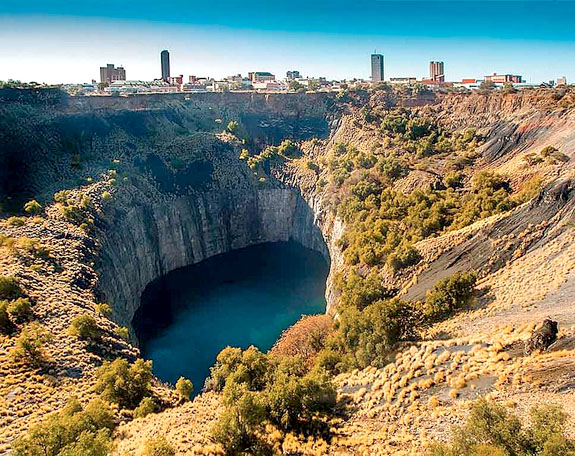
Although active mining at the Big Hole ended nine years ago, the mine in South Africa still recovers more than 700,000 carats per year by using advanced X-ray technology to sift through the tailings, or waste rock, that old-timers discarded generations ago.
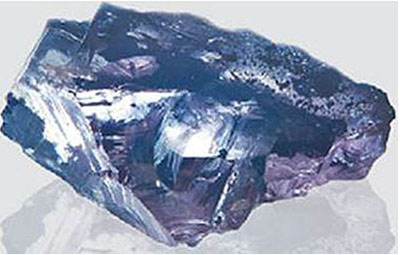
Only three weeks ago, we reported on a super-rare 30.80-carat Kimberley Purple, a rough diamond that was salvaged at the diamond tailings plant in Kimberley. The gem could be worth more than $1 million per carat.
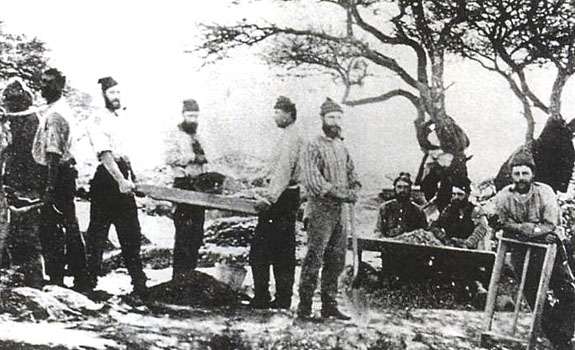
Originally, the Big Hole — which currently measures 700 feet deep and 1,500 feet in width — was not a hole at all. In 1871, an 83.5-carat diamond was found on the slopes of Colesberg Kopje, sparking a diamond rush in the area. Miners flocked to the site by the tens of thousands, and the hill at Colesberg Kopje quickly turned into a giant cavity, following the subterranean path of a diamond-laden kimberlite pipe.
The Big Hole is believed to be the largest hand-dug excavation on earth. At peak operation in the early 1900s it employed 50,000 laborers who used nothing more sophisticated than a pick and a spade to move more than 22 million tons of earth in their quest for diamonds.
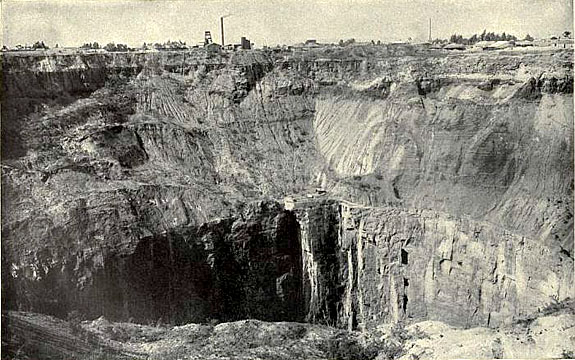
The De Beers Group had planned to retire its Kimberley Mine operations in 2018, but now believes the tailings-recovery business can still be viable through 2030 — for the right operator.
“It’ll still be profitable in 10 years,” De Beers spokesman Tom Tweedy told The Wall Street Journal. “But the scale better suits a smaller, lower-cost operator.”
The company did not say how much it was seeking for the mine, but did report that the mine is generating hundreds of millions of dollars per year in revenue and more than $100 million in profit. De Beers hopes to conclude a deal within the next few months.
Englishman Cecil Rhodes founded De Beers in 1880. Based on the riches earned at the Kimberley, Rhodes controlled 90% of the world’s rough diamond supply by the time of his death in 1902.
Images: Kimberley Mine by Hein Waschefort [CC BY-SA 3.0] via Wikimedia Commons; Kimberley Purple via nationaljeweler.com (uncredited); Kimberley Mine in 1902 by Encyclopædia Britannica via Wikimedia Commons; Prospectors on Colesberg Kopje in 1871 via Wikimedia Commons.
Although active mining at the Big Hole ended nine years ago, the mine in South Africa still recovers more than 700,000 carats per year by using advanced X-ray technology to sift through the tailings, or waste rock, that old-timers discarded generations ago.
Only three weeks ago, we reported on a super-rare 30.80-carat Kimberley Purple, a rough diamond that was salvaged at the diamond tailings plant in Kimberley. The gem could be worth more than $1 million per carat.
Originally, the Big Hole — which currently measures 700 feet deep and 1,500 feet in width — was not a hole at all. In 1871, an 83.5-carat diamond was found on the slopes of Colesberg Kopje, sparking a diamond rush in the area. Miners flocked to the site by the tens of thousands, and the hill at Colesberg Kopje quickly turned into a giant cavity, following the subterranean path of a diamond-laden kimberlite pipe.
The Big Hole is believed to be the largest hand-dug excavation on earth. At peak operation in the early 1900s it employed 50,000 laborers who used nothing more sophisticated than a pick and a spade to move more than 22 million tons of earth in their quest for diamonds.
The De Beers Group had planned to retire its Kimberley Mine operations in 2018, but now believes the tailings-recovery business can still be viable through 2030 — for the right operator.
“It’ll still be profitable in 10 years,” De Beers spokesman Tom Tweedy told The Wall Street Journal. “But the scale better suits a smaller, lower-cost operator.”
The company did not say how much it was seeking for the mine, but did report that the mine is generating hundreds of millions of dollars per year in revenue and more than $100 million in profit. De Beers hopes to conclude a deal within the next few months.
Englishman Cecil Rhodes founded De Beers in 1880. Based on the riches earned at the Kimberley, Rhodes controlled 90% of the world’s rough diamond supply by the time of his death in 1902.
Images: Kimberley Mine by Hein Waschefort [CC BY-SA 3.0] via Wikimedia Commons; Kimberley Purple via nationaljeweler.com (uncredited); Kimberley Mine in 1902 by Encyclopædia Britannica via Wikimedia Commons; Prospectors on Colesberg Kopje in 1871 via Wikimedia Commons.
Friday, 22 May 2015
Music Friday: Rob Thomas’ 2009 Hit ‘Her Diamonds’ Is an Intimate Tale of Empathy and Love
MAY 22ND, 2015
joantaras.com
Welcome to Music Friday when we bring you hit songs with jewelry, gemstones or precious metals in the title or lyrics. Today we feature Rob Thomas singing his 2009 hit, “Her Diamonds,” an intimate and heartfelt song about his wife’s struggles with a rare autoimmune disease.

In the song, Thomas uses the phrase “her diamonds” as a metaphor for his wife’s tears. He sings, “And she says oh / I can't take no more / Her tears like diamonds on the floor / And her diamonds bring me down / Cause I can't help her now.”
In an interview with The Canadian Press, Thomas revealed that the song was about his wife, Marisol, although his intention was to have the song transcend the personal.
“My wife has an autoimmune disease and [we’ve had to] deal with that for the last six or seven years,” he said. “But at the end of the day, it's really a song about being empathetic, when the person closest to you is going through something and you can't do anything to make it better, except to be there for them.”
“Her Diamonds,” which was the lead song from Thomas’s second solo album, Cradlesong, zoomed to #1 on the U.S. Billboard Adult Pop Songs chart and topped out at #23 on the US Billboard Hot 100 chart.
Fans of Thomas, who is also the frontman for Matchbox Twenty, may remember the chilling official video for “Her Diamonds.” Actress Alicia Silverstone (Clueless) stars in the video as a woman trapped in a thick coating of ice. She sits petrified and motionless on a bed, staring out the window. But, slowly, the sunlight from the window melts the ice, releasing Silverstone from her icy chrysalis.
Obviously, this represents Thomas’ hope that his wife will overcome the disease and have a bright future.
Thomas noted that Marisol was intimately involved with the song. She sang backup on the track and produce the arrangement.
We hope you enjoy the official video of “Her Diamonds,” a YouTube sensation that has been viewed more than three million times. The lyrics are below if you’d like to sing along.
"Her Diamonds"
Written and performed by Rob Thomas.
Oh what the hell she said
I just can't win for losing
And she lays back down
Man there's so many times
I don't know what I'm doing
Like I don't know now
By the light of the moon
She rubs her eyes
Says it's funny how the night
Can make you blind
I can just imagine
And I don't know what I'm supposed to do
But if she feels bad then i do too
So I let her be
And she says oh
I can't take no more
Her tears like diamonds on the floor
And her diamonds bring me down
Cause I can't help her now
She's down in it
She tried her best but now she can't win it
Hard to see them on the ground
Her diamonds falling down
She sits down and stares into the distance
And it takes all night
And i know i could break her concentration
But it don't feel right
By the light of the moon
She rubs her eyes
Sits down on the bed and starts to cry
And there's something less about her
And I don't know what I'm supposed to do
So I sit down and I cry too
And don't let her see
And she says oh
I can't take no more
Her tears like diamonds on the floor
And her diamonds bring me down
Cause I can't help her now
She's down in it
She tried her best but now she can't win it
Hard to see them on the ground
Her diamonds falling down
She shuts out the night
Tries to close her eyes
If she can find daylight
She'll be alright
She'll be alright
Just not tonight
And she says oh
I can't take no more
Her tears like diamonds on the floor
And her diamonds bring me down
Cause I can't help her now
She's down in it
She tried her best but now she can't win it
Hard to see them on the ground
Her diamonds falling down
Image: YouTube screen capture.
In an interview with The Canadian Press, Thomas revealed that the song was about his wife, Marisol, although his intention was to have the song transcend the personal.
“My wife has an autoimmune disease and [we’ve had to] deal with that for the last six or seven years,” he said. “But at the end of the day, it's really a song about being empathetic, when the person closest to you is going through something and you can't do anything to make it better, except to be there for them.”
“Her Diamonds,” which was the lead song from Thomas’s second solo album, Cradlesong, zoomed to #1 on the U.S. Billboard Adult Pop Songs chart and topped out at #23 on the US Billboard Hot 100 chart.
Fans of Thomas, who is also the frontman for Matchbox Twenty, may remember the chilling official video for “Her Diamonds.” Actress Alicia Silverstone (Clueless) stars in the video as a woman trapped in a thick coating of ice. She sits petrified and motionless on a bed, staring out the window. But, slowly, the sunlight from the window melts the ice, releasing Silverstone from her icy chrysalis.
Obviously, this represents Thomas’ hope that his wife will overcome the disease and have a bright future.
Thomas noted that Marisol was intimately involved with the song. She sang backup on the track and produce the arrangement.
We hope you enjoy the official video of “Her Diamonds,” a YouTube sensation that has been viewed more than three million times. The lyrics are below if you’d like to sing along.
"Her Diamonds"
Written and performed by Rob Thomas.
I just can't win for losing
And she lays back down
Man there's so many times
I don't know what I'm doing
Like I don't know now
By the light of the moon
She rubs her eyes
Says it's funny how the night
Can make you blind
I can just imagine
And I don't know what I'm supposed to do
But if she feels bad then i do too
So I let her be
And she says oh
I can't take no more
Her tears like diamonds on the floor
And her diamonds bring me down
Cause I can't help her now
She's down in it
She tried her best but now she can't win it
Hard to see them on the ground
Her diamonds falling down
She sits down and stares into the distance
And it takes all night
And i know i could break her concentration
But it don't feel right
By the light of the moon
She rubs her eyes
Sits down on the bed and starts to cry
And there's something less about her
And I don't know what I'm supposed to do
So I sit down and I cry too
And don't let her see
And she says oh
I can't take no more
Her tears like diamonds on the floor
And her diamonds bring me down
Cause I can't help her now
She's down in it
She tried her best but now she can't win it
Hard to see them on the ground
Her diamonds falling down
She shuts out the night
Tries to close her eyes
If she can find daylight
She'll be alright
She'll be alright
Just not tonight
And she says oh
I can't take no more
Her tears like diamonds on the floor
And her diamonds bring me down
Cause I can't help her now
She's down in it
She tried her best but now she can't win it
Hard to see them on the ground
Her diamonds falling down
Image: YouTube screen capture.
Thursday, 21 May 2015
Rare African Plant Signals Diamonds in the Soil Below
MAY 21ST, 2015
joantaras.com
A Florida geologist has discovered an unusual palm-like plant that only grows in diamond-rich soil.
More specifically, the stilted, thorny Pandanus candelabrum thrives in the potassium, phosphorous and magnesium-rich soil that sits above kimberlite pipes — the volcanic superhighways that deliver precious diamonds from deep within the earth to the surface.
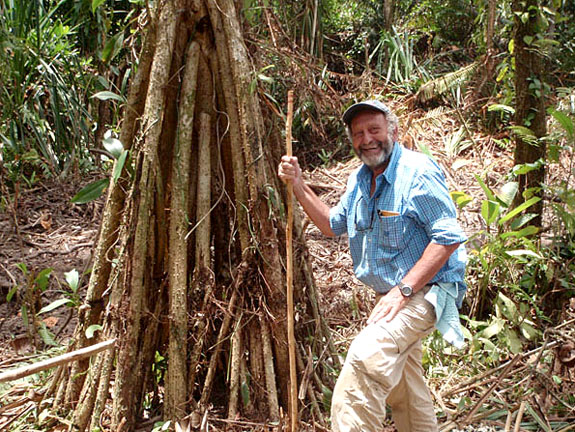
Most of the world’s commercial diamond production is derived from kimberlite pipes and the Pandanus candelabrum plant is the world's only botanical indicator for kimberlite. Where you find this rare plant, you're likely to find diamonds.
Stephen Haggerty, a professor of geophysics at Florida International University in Miami, is credited with making the connection between the palm plant and diamond prospecting. He published his findings in the June-July edition of Economic Geology.

The special connection between kimberlite and the strange plant with stilt-like roots could change the way prospectors in West Africa search for diamonds. Instead of utilizing heavy gear for strip mining, they can simply pinpoint their excavation efforts to where the prickly palm is flourishing — thereby preserving the environment.
Hagerty claims that, until recently, there was no reliable way to locate these small, but concentrated, deposits of diamonds hidden in the remote and dense jungle. Some diamond-rich areas are only a few acres in size.
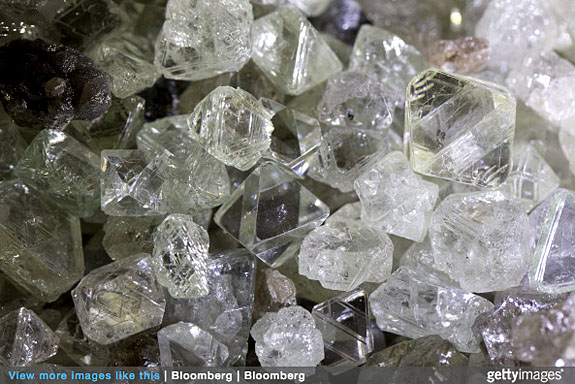
According to Science magazine, Hagerty’s clever hypothesis is already yielding real results. In a test site inhabited by the Pandanus candelabrum, Hagerty secured four diamonds, two of them around 20 carats apiece.
Interestingly, the palm/diamond association has been played out with other flora and precious materials across the globe.
In 2013, we wrote about Australian researchers who discovered that the roots of eucalyptus trees have the ability to draw up tiny gold particles from deep within the soil, with the gold eventually collecting in the leaves and branches. Finding precious metal in the leaves is a certain indicator of the presence of valuable gold deposits 100 feet or more below the surface.
Science magazine reported that Lychnis alpina, a small pink-flowering plant in Scandinavia, and Haumaniastrum katangense, a white-flowered shrub in central Africa, are both associated with copper. And PBS.com noted that a the presence of a certain type of grass native to California is a dependable sign of nickel and chromium in the soil.
Credits: Photo of Stephen Haggerty and the Pandanus candelabrum: Uncredited via fiu.edu.; Tree by Jakob Fahr/iNaturalist (CC BY-NC) via Wikimedia Commons; Rough diamonds via Getty Images.
More specifically, the stilted, thorny Pandanus candelabrum thrives in the potassium, phosphorous and magnesium-rich soil that sits above kimberlite pipes — the volcanic superhighways that deliver precious diamonds from deep within the earth to the surface.
Most of the world’s commercial diamond production is derived from kimberlite pipes and the Pandanus candelabrum plant is the world's only botanical indicator for kimberlite. Where you find this rare plant, you're likely to find diamonds.
Stephen Haggerty, a professor of geophysics at Florida International University in Miami, is credited with making the connection between the palm plant and diamond prospecting. He published his findings in the June-July edition of Economic Geology.
The special connection between kimberlite and the strange plant with stilt-like roots could change the way prospectors in West Africa search for diamonds. Instead of utilizing heavy gear for strip mining, they can simply pinpoint their excavation efforts to where the prickly palm is flourishing — thereby preserving the environment.
Hagerty claims that, until recently, there was no reliable way to locate these small, but concentrated, deposits of diamonds hidden in the remote and dense jungle. Some diamond-rich areas are only a few acres in size.

According to Science magazine, Hagerty’s clever hypothesis is already yielding real results. In a test site inhabited by the Pandanus candelabrum, Hagerty secured four diamonds, two of them around 20 carats apiece.
Interestingly, the palm/diamond association has been played out with other flora and precious materials across the globe.
In 2013, we wrote about Australian researchers who discovered that the roots of eucalyptus trees have the ability to draw up tiny gold particles from deep within the soil, with the gold eventually collecting in the leaves and branches. Finding precious metal in the leaves is a certain indicator of the presence of valuable gold deposits 100 feet or more below the surface.
Science magazine reported that Lychnis alpina, a small pink-flowering plant in Scandinavia, and Haumaniastrum katangense, a white-flowered shrub in central Africa, are both associated with copper. And PBS.com noted that a the presence of a certain type of grass native to California is a dependable sign of nickel and chromium in the soil.
Credits: Photo of Stephen Haggerty and the Pandanus candelabrum: Uncredited via fiu.edu.; Tree by Jakob Fahr/iNaturalist (CC BY-NC) via Wikimedia Commons; Rough diamonds via Getty Images.
Wednesday, 20 May 2015
Gerhard Wagner’s World-Class Collection of Tourmaline to Hit the Auction Block in Dallas on June 7
MAY 20TH, 2015
joantaras.com
Gerhard Wagner’s world-class collection of tourmaline — 432 lots in all with some valued at more than $500,000 — will be up for bid at Heritage Auctions in Dallas on June 7.
Wagner, who is known as the “King of Tourmalines,” has been carefully cultivating his museum-quality treasures for decades.
“This is like a king opening the crown jewels to bids from his subjects,” said Jim Walker, Director of Fine Minerals auctions at Heritage. “Collectors are chomping at the bit to obtain just a single piece of his extraordinary collection.”
Some of the top lots of the auction include the following:
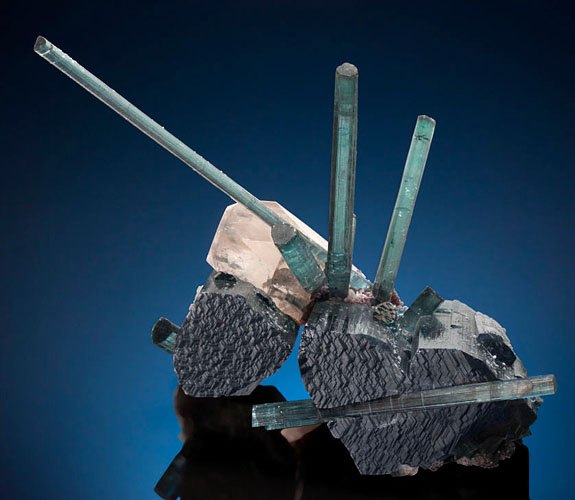
“Blue on Blue” — tourmaline on tourmaline with quartz from the Porcupine Pocket of the Pederneira Mine, Brazil, shown above (Estimate: $500,000 - $700,000).
Recovered in 2001, this specimen features two major crystal types: thin and long, or stout and wide. The longest thin crystal is an enormously elongated thin blue prism 9.25 x 0.31 inches in size, and there are several shorter ones of similar proportions. The stout tourmalines are approximately 3.93 inches across, and 4.8 inches long. The overall measurements are 5.5 x 9.1 x 6.3 inches.
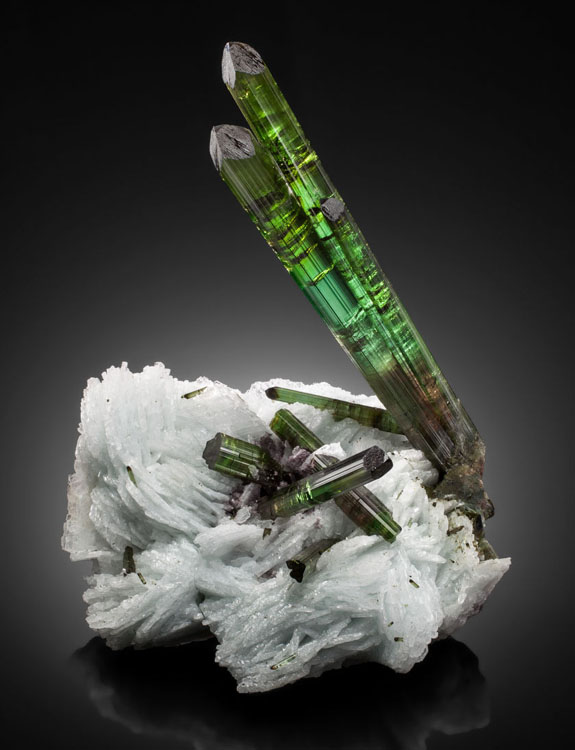
“Blastoff” — tourmaline on cleavelandite from the Grandon Pocket of the Pederneira Mine, Brazil (Estimate: $450,000 -$650,000).
Rising from a pure white base of bladed cleavelandite is a stunning group of multi-colored tourmaline crystals of elongated form. The specimen is composed of roughly six crystals, but the aggregate is strongly dominated by a group displaying a radiating habit with three terminated crystals taking flight from the matrix, hence the name "Blastoff." The overall measurements are 5.6 x 5.4 x 6.6 inches.
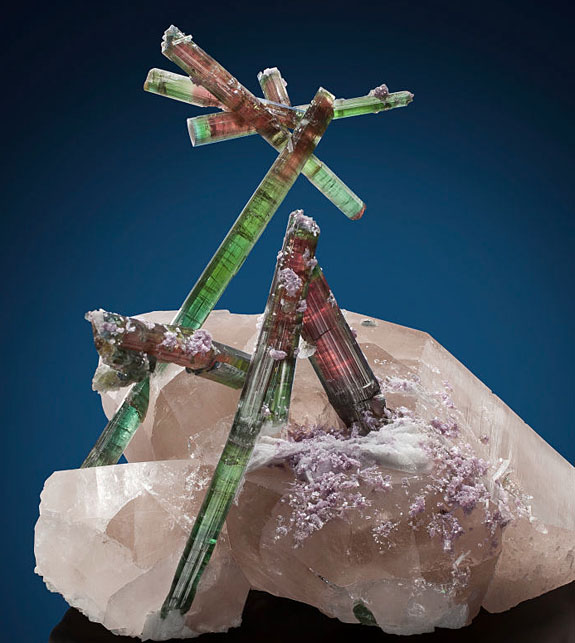
“Flower of Pederneira” — tourmaline on quartz with lepidolite and cleavelandite from the Proud Pocket of the Pederneira Mine, Brazil (Estimate: $300,000 - $500,000).
This specimen is unique in a number of ways. First, it features a "flower," which is actually a cluster of four crystals attached at the termination of an already superb prism measuring 6.18 inches in length. Of the "flower" cluster, three of the four are double-terminated. A second unusual characteristic is a “bent” crystal measuring 5.31 inches long.
Heritage is promoting the June 7 auction as an opportunity for non-collectors to learn about the beauty and value of the specimens as not just as minerals, but as magnificent pieces of fine art.

“This collection illustrates the fact that the beauty of high-quality mineral specimens make them objects comparable to the most refined forms of art,” wrote Milan-based Mineralogy Museum curator Dr. Federico Pezzotta in the coffee table book, The World of Tourmaline. The publication features 379 vivid images of Wagner’s breathtaking discoveries.
According to Heritage Auctions, Wagner’s passion for collecting fine minerals dates back to his childhood, well before he could ever consider buying any of the specimens that have made him famous.
The fascination that began as a child picking up fossils on the shores of Lake Constance, on the Rhine River in Germany, became a process of education, collecting and patience that have led to him being one of the most respected and well-liked names in the business, noted the auction house.
Images: Heritage Auctions.
Wagner, who is known as the “King of Tourmalines,” has been carefully cultivating his museum-quality treasures for decades.
“This is like a king opening the crown jewels to bids from his subjects,” said Jim Walker, Director of Fine Minerals auctions at Heritage. “Collectors are chomping at the bit to obtain just a single piece of his extraordinary collection.”
Some of the top lots of the auction include the following:
“Blue on Blue” — tourmaline on tourmaline with quartz from the Porcupine Pocket of the Pederneira Mine, Brazil, shown above (Estimate: $500,000 - $700,000).
Recovered in 2001, this specimen features two major crystal types: thin and long, or stout and wide. The longest thin crystal is an enormously elongated thin blue prism 9.25 x 0.31 inches in size, and there are several shorter ones of similar proportions. The stout tourmalines are approximately 3.93 inches across, and 4.8 inches long. The overall measurements are 5.5 x 9.1 x 6.3 inches.
“Blastoff” — tourmaline on cleavelandite from the Grandon Pocket of the Pederneira Mine, Brazil (Estimate: $450,000 -$650,000).
Rising from a pure white base of bladed cleavelandite is a stunning group of multi-colored tourmaline crystals of elongated form. The specimen is composed of roughly six crystals, but the aggregate is strongly dominated by a group displaying a radiating habit with three terminated crystals taking flight from the matrix, hence the name "Blastoff." The overall measurements are 5.6 x 5.4 x 6.6 inches.
“Flower of Pederneira” — tourmaline on quartz with lepidolite and cleavelandite from the Proud Pocket of the Pederneira Mine, Brazil (Estimate: $300,000 - $500,000).
This specimen is unique in a number of ways. First, it features a "flower," which is actually a cluster of four crystals attached at the termination of an already superb prism measuring 6.18 inches in length. Of the "flower" cluster, three of the four are double-terminated. A second unusual characteristic is a “bent” crystal measuring 5.31 inches long.
Heritage is promoting the June 7 auction as an opportunity for non-collectors to learn about the beauty and value of the specimens as not just as minerals, but as magnificent pieces of fine art.
“This collection illustrates the fact that the beauty of high-quality mineral specimens make them objects comparable to the most refined forms of art,” wrote Milan-based Mineralogy Museum curator Dr. Federico Pezzotta in the coffee table book, The World of Tourmaline. The publication features 379 vivid images of Wagner’s breathtaking discoveries.
According to Heritage Auctions, Wagner’s passion for collecting fine minerals dates back to his childhood, well before he could ever consider buying any of the specimens that have made him famous.
The fascination that began as a child picking up fossils on the shores of Lake Constance, on the Rhine River in Germany, became a process of education, collecting and patience that have led to him being one of the most respected and well-liked names in the business, noted the auction house.
Images: Heritage Auctions.
Tuesday, 19 May 2015
Watch a Scientist Set a Diamond Ablaze in This Fascinating Lab Experiment
MAY 19TH, 2015
joantaras.com
Sitting on its lofty perch atop the Mohs scale, diamond is the hardest naturally occurring material known to man. It is harder than a ruby, sapphire or emerald and has the ability to slice through steel like a hot knife through butter. The only substance that can scratch a diamond is another diamond.
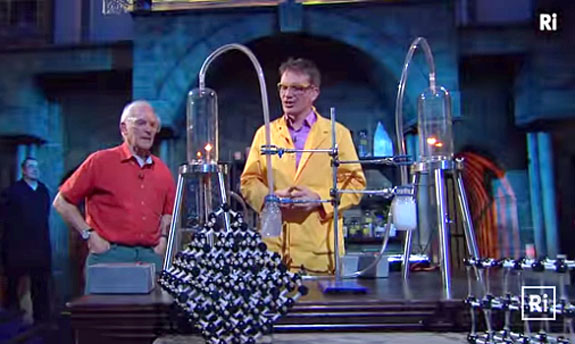
Under normal circumstances, diamonds truly are forever. But in the labs of the British Royal Institution, the famous De Beers ad slogan — not to mention the theme of the Shirley Bassey hit song — has been put to the test.
Because a diamond is made of pure carbon, scientists have theorized since the 1700s that a diamond should burn like other carbon materials, such as graphite or coal.
And, indeed, during the early 1770s, French chemist Antoine Lavoisier used two powerful lenses to magnify the sun’s rays directly onto a diamond. The diamond slowly disappeared and carbon dioxide gas accumulated, proving that the diamond was made from carbon.
In the video below, British scientist and author Peter Wothers enlists the help of Nobel prize-winning chemist Sir Harry Kroto to demonstrate what it takes to get a diamond to burn.
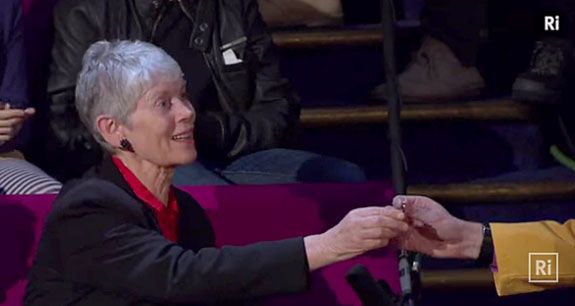
Wothers adds a bit of drama and comic relief by using Kroto’s wife’s engagement diamond for the experiment. The viewer can see Kroto getting increasingly more uncomfortable as it becomes very clear that his wife’s diamond — under the right conditions — will ignite.

In pure oxygen, diamonds can ignite at 1320 degrees F. In normal conditions, the ignition occurs at about 1520 degrees F.
Wother’s experiment is conducted in a chamber of pure oxygen. The resulting gases are collected in a tube leading to a beaker of limewater. The experiment anticipates that if the burning material contains carbon, the smoke will contain carbon dioxide. When the carbon dioxide mixes into the limewater, it turns the mixture a milky white color — basically delivering calcium carbonate, an antacid used to calm a sour stomach.
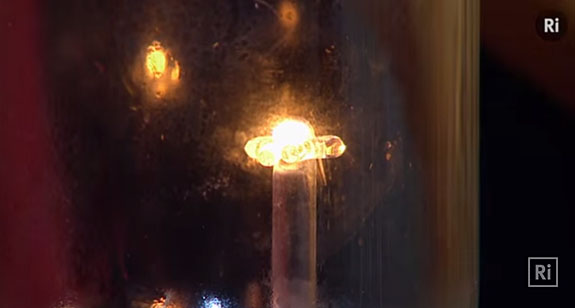
Wother’s does his first experiment using a bit of graphite, which he easily ignites using a torch. Then he ups the ante by doing the exact same experiment using the Kroto engagement diamond.
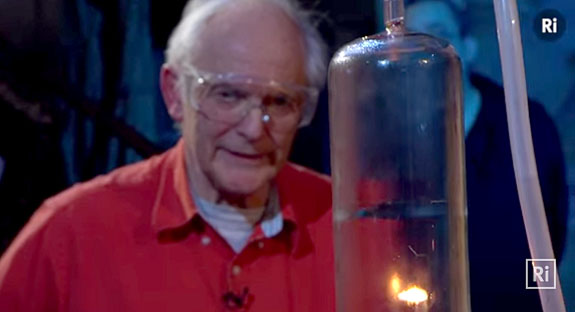
Surprisingly, that lights up, too. The diamond burns as a golden ember without producing any flames. At this point, Kroto half-jokingly comments that he hopes the show can pay for a replacement diamond.
As you might have figured out by now, Wother had cleverly swapped the Krotos’ engagement diamond with a much lower quality specimen before the experiment began.
If you’re worried about how a diamond is protected when a ring needs to be retipped, for example, be assured that jewelers go to great lengths to make sure that the extreme heat of the torch does not affect the gemstone. Some jewelers use boron to protect the stone while others depend on the pinpoint accuracy of a laser welder to keep the diamond out of harm’s way.
Kroto won his Nobel Prize in Chemistry in 1996 for his work in discovering fullerenes, a pure carbon molecule that takes a shape similar to a soccer ball. Recent research has suggested many uses for fullerenes, including medical applications, superconductors, fiber-optics systems and nanotechnology.
Check out Wother’s diamond-burning experiment here…
Images: YouTube screen captures.

Under normal circumstances, diamonds truly are forever. But in the labs of the British Royal Institution, the famous De Beers ad slogan — not to mention the theme of the Shirley Bassey hit song — has been put to the test.
Because a diamond is made of pure carbon, scientists have theorized since the 1700s that a diamond should burn like other carbon materials, such as graphite or coal.
And, indeed, during the early 1770s, French chemist Antoine Lavoisier used two powerful lenses to magnify the sun’s rays directly onto a diamond. The diamond slowly disappeared and carbon dioxide gas accumulated, proving that the diamond was made from carbon.
In the video below, British scientist and author Peter Wothers enlists the help of Nobel prize-winning chemist Sir Harry Kroto to demonstrate what it takes to get a diamond to burn.
Wothers adds a bit of drama and comic relief by using Kroto’s wife’s engagement diamond for the experiment. The viewer can see Kroto getting increasingly more uncomfortable as it becomes very clear that his wife’s diamond — under the right conditions — will ignite.

In pure oxygen, diamonds can ignite at 1320 degrees F. In normal conditions, the ignition occurs at about 1520 degrees F.
Wother’s experiment is conducted in a chamber of pure oxygen. The resulting gases are collected in a tube leading to a beaker of limewater. The experiment anticipates that if the burning material contains carbon, the smoke will contain carbon dioxide. When the carbon dioxide mixes into the limewater, it turns the mixture a milky white color — basically delivering calcium carbonate, an antacid used to calm a sour stomach.
Wother’s does his first experiment using a bit of graphite, which he easily ignites using a torch. Then he ups the ante by doing the exact same experiment using the Kroto engagement diamond.
Surprisingly, that lights up, too. The diamond burns as a golden ember without producing any flames. At this point, Kroto half-jokingly comments that he hopes the show can pay for a replacement diamond.
As you might have figured out by now, Wother had cleverly swapped the Krotos’ engagement diamond with a much lower quality specimen before the experiment began.
If you’re worried about how a diamond is protected when a ring needs to be retipped, for example, be assured that jewelers go to great lengths to make sure that the extreme heat of the torch does not affect the gemstone. Some jewelers use boron to protect the stone while others depend on the pinpoint accuracy of a laser welder to keep the diamond out of harm’s way.
Kroto won his Nobel Prize in Chemistry in 1996 for his work in discovering fullerenes, a pure carbon molecule that takes a shape similar to a soccer ball. Recent research has suggested many uses for fullerenes, including medical applications, superconductors, fiber-optics systems and nanotechnology.
Check out Wother’s diamond-burning experiment here…
Images: YouTube screen captures.
Monday, 18 May 2015
35.1-Carat Kashmir Sapphire Sets Per-Carat Record at Christie’s Geneva
MAY 18TH, 2015
joantaras.com
Displaying the velvety blue hue of a peacock’s neck feathers, a 35.09-carat Kashmir sapphire set a new record at Christie’s Geneva last week when it fetched $7.4 million — crushing the pre-sale high estimate of $4.3 million.
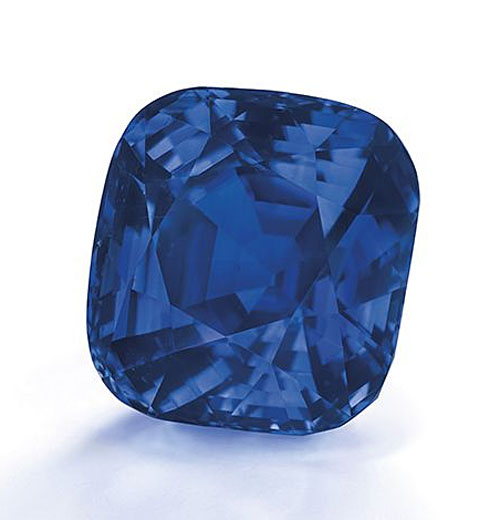
The gem’s per-carat selling price of $209,689 established a new high-water mark for a Kashmir sapphire, narrowly edging out a record set one day earlier at Sotheby’s Geneva. That Kashmir sapphire, a 30.23-carat stunner, had sold for $6.1 million, or $201,786 per carat.
The cushion-shaped record-setting sapphire was set in a ring with triangular-cut diamond shoulders and baguette-cut diamonds accents. An anonymous Asian bidder made the purchase via phone.
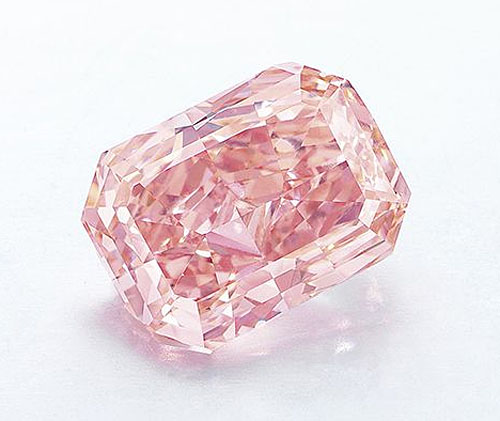
Other highlights from the Christie’s auction included the top lot of the night — a 5.18-carat rectangular-cut fancy vivid pink diamond that sold for $10.8 million, or $2.1 million per carat. The hammer price was on the lower end of the pre-sale estimate of $10.2 million to $13.4 million.
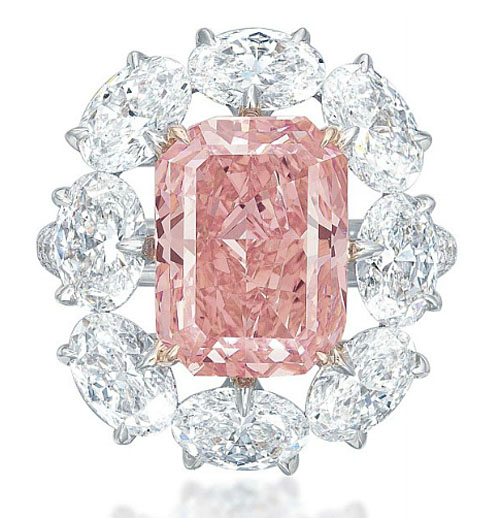
The pink stone, which was purchased by an anonymous buyer, is set in a ring with an oval-shaped surround of colorless oval-cut diamonds.
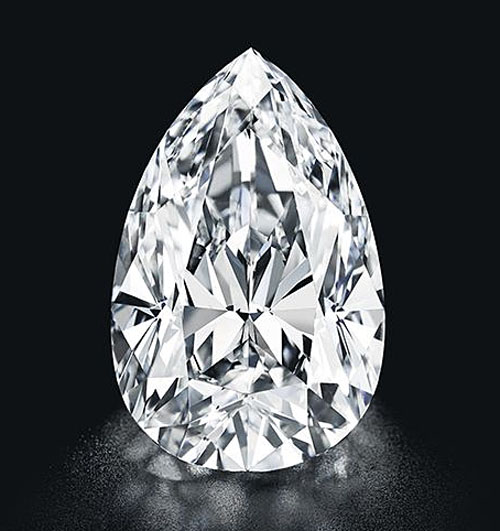
Selling for $9.03 million, or $162,711 per carat, was this stunning pear-shaped flawless Type IIa diamond weighing 55.5 carats. It was purchased by an Asian private buyer via telephone and the hammer price was within the pre-sale estimate of $8.5 million to $10 million.
Type IIa diamonds are considered the purest of all diamonds because they are composed solely of carbon with virtually no trace elements in the crystal lattice.
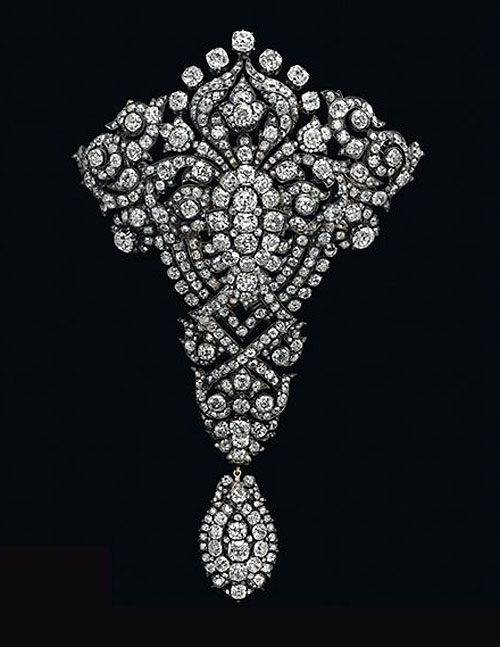
The biggest disappointment of the Christie’s Geneva sale was a 19th century diamond brooch linked to Spain's royal family. Featured on the cover of the auction house’s catalog, the final bid of 900,000 Swiss francs (about $982,000) failed to reach the secret reserve price set by the seller, thus going unsold.
The brooch had been given by Spain's King Alfonso XII to the Archduchess Maria Christina of Austria for their wedding in 1879 and remained with the family until the 1980s.
Credit: Christie's Images Ltd. 2015
The gem’s per-carat selling price of $209,689 established a new high-water mark for a Kashmir sapphire, narrowly edging out a record set one day earlier at Sotheby’s Geneva. That Kashmir sapphire, a 30.23-carat stunner, had sold for $6.1 million, or $201,786 per carat.
The cushion-shaped record-setting sapphire was set in a ring with triangular-cut diamond shoulders and baguette-cut diamonds accents. An anonymous Asian bidder made the purchase via phone.
Other highlights from the Christie’s auction included the top lot of the night — a 5.18-carat rectangular-cut fancy vivid pink diamond that sold for $10.8 million, or $2.1 million per carat. The hammer price was on the lower end of the pre-sale estimate of $10.2 million to $13.4 million.
The pink stone, which was purchased by an anonymous buyer, is set in a ring with an oval-shaped surround of colorless oval-cut diamonds.
Selling for $9.03 million, or $162,711 per carat, was this stunning pear-shaped flawless Type IIa diamond weighing 55.5 carats. It was purchased by an Asian private buyer via telephone and the hammer price was within the pre-sale estimate of $8.5 million to $10 million.
Type IIa diamonds are considered the purest of all diamonds because they are composed solely of carbon with virtually no trace elements in the crystal lattice.

The biggest disappointment of the Christie’s Geneva sale was a 19th century diamond brooch linked to Spain's royal family. Featured on the cover of the auction house’s catalog, the final bid of 900,000 Swiss francs (about $982,000) failed to reach the secret reserve price set by the seller, thus going unsold.
The brooch had been given by Spain's King Alfonso XII to the Archduchess Maria Christina of Austria for their wedding in 1879 and remained with the family until the 1980s.
Credit: Christie's Images Ltd. 2015
Friday, 15 May 2015
Music Friday: Lady Antebellum Sings, ‘You Shine Like Diamonds’ in 2008’s ‘Love’s Lookin’ Good on You’
MAY 15TH, 2015
joantaras.com
Welcome to Music Friday when we bring you fun songs with jewelry, gemstones or precious metals in the title or lyrics. Today we have country music trio Lady Antebellum singing “Love’s Lookin’ Good on You” from their 2008 chart-topping self-titled album.

The premise of the song is that a woman in love undergoes a beautiful and undeniable transformation. She beams with confidence, her eyes are twice as bright and she looks like a million bucks.
Lady Antebellum sings, “How your sweet smile has a way of / Lighting up the room / Yeah you shine like diamonds / In everything you do / Oh love, love, love is looking good/ Good, good on you.”
“Love’s Lookin’ Good on You” is the sixth track on the group’s inaugural album Lady Antebellum, which released in April of 2008 and made its debut at #1 on the Billboard Top Country Albums chart. It was also a crossover success, as it reached #4 on the Billboard Top 200 albums chart.
The multi-Grammy-award-winning Lady Antebellum is composed of the multitalented trio of Hillary Scott (lead and background vocals), Charles Kelley (lead and background vocals, guitar) and Dave Haywood (background vocals, guitar, piano, mandolin). The group got its start in Nashville in 2006 and signed with Capitol Records a year later.
Since then, the group has released five albums and 16 singles, nine of which reached #1 on the Billboard Hot Country Songs chart.
Lady Antebellum scored Grammys in 2012 for Song of the Year and Record of the Year, and another in 2013 for Best Country Album. The trio is credited with selling more than 12.5 million digital singles and 10 million albums in the U.S.
Check out the awesome 2008 live performance of Lady Antebellum singing “Love’s Lookin’ Good on You.” The studio session was sponsored by radio station 96.9 "The Kat" in Charlotte, N.C. And, as always, the lyrics are below if you’d like to sing along.
"Love's Lookin' Good on You"
Written by Victoria Lynn Shaw, Jason Deere and Matt Lopez. Performed by Lady Antebellum.
Oh baby, baby something's just a little bit different
In your eyes tonight,
Why they look twice as bright.
Oh baby, baby something's changed,
That I can't quite put my finger on,
Well I've been racking my brain,
Wait just a minute,
Well hold on now,
Well I'll get it.
[Chorus]
Love, love, love is looking good,
Good, good on you,
Can you feel it
Oh everybody sees it.
How your sweet smile has a way of,
Lighting up the room,
Yeah you shine like diamonds,
In everything you do.
Oh love, love, love is looking good,
Good, good on you.
Oh baby, baby,
Isn't it funny,
How we don't need any money,
Just a little love to look like a million bucks
Oh baby, baby,
Kinda makes you think that the stars were in sync on the night we met.
There'll probably be a red carpet everywhere you go,
Throw it on out hey don't you know.
[Chorus]
I knew right away from the very first kiss,
That it just doesn't get much better than this.
We fit just like a favorite pair of jeans.
We just keep coming back for more,
Like two kids in a candy store.
And now I know what everybody means when they say.
[Chorus]
I'm telling you mighty, mighty good babe.
Love, love, love is looking,
Good, good, good on you,
Love is looking good on you.
Love, love, love is looking
Good, good, good on you
Image: Instagram/Lady Antebellum
The premise of the song is that a woman in love undergoes a beautiful and undeniable transformation. She beams with confidence, her eyes are twice as bright and she looks like a million bucks.
Lady Antebellum sings, “How your sweet smile has a way of / Lighting up the room / Yeah you shine like diamonds / In everything you do / Oh love, love, love is looking good/ Good, good on you.”
“Love’s Lookin’ Good on You” is the sixth track on the group’s inaugural album Lady Antebellum, which released in April of 2008 and made its debut at #1 on the Billboard Top Country Albums chart. It was also a crossover success, as it reached #4 on the Billboard Top 200 albums chart.
The multi-Grammy-award-winning Lady Antebellum is composed of the multitalented trio of Hillary Scott (lead and background vocals), Charles Kelley (lead and background vocals, guitar) and Dave Haywood (background vocals, guitar, piano, mandolin). The group got its start in Nashville in 2006 and signed with Capitol Records a year later.
Since then, the group has released five albums and 16 singles, nine of which reached #1 on the Billboard Hot Country Songs chart.
Lady Antebellum scored Grammys in 2012 for Song of the Year and Record of the Year, and another in 2013 for Best Country Album. The trio is credited with selling more than 12.5 million digital singles and 10 million albums in the U.S.
Check out the awesome 2008 live performance of Lady Antebellum singing “Love’s Lookin’ Good on You.” The studio session was sponsored by radio station 96.9 "The Kat" in Charlotte, N.C. And, as always, the lyrics are below if you’d like to sing along.
"Love's Lookin' Good on You"
Written by Victoria Lynn Shaw, Jason Deere and Matt Lopez. Performed by Lady Antebellum.
Oh baby, baby something's just a little bit different
In your eyes tonight,
Why they look twice as bright.
Oh baby, baby something's changed,
That I can't quite put my finger on,
Well I've been racking my brain,
Wait just a minute,
Well hold on now,
Well I'll get it.
[Chorus]
Love, love, love is looking good,
Good, good on you,
Can you feel it
Oh everybody sees it.
How your sweet smile has a way of,
Lighting up the room,
Yeah you shine like diamonds,
In everything you do.
Oh love, love, love is looking good,
Good, good on you.
Oh baby, baby,
Isn't it funny,
How we don't need any money,
Just a little love to look like a million bucks
Oh baby, baby,
Kinda makes you think that the stars were in sync on the night we met.
There'll probably be a red carpet everywhere you go,
Throw it on out hey don't you know.
[Chorus]
I knew right away from the very first kiss,
That it just doesn't get much better than this.
We fit just like a favorite pair of jeans.
We just keep coming back for more,
Like two kids in a candy store.
And now I know what everybody means when they say.
[Chorus]
I'm telling you mighty, mighty good babe.
Love, love, love is looking,
Good, good, good on you,
Love is looking good on you.
Love, love, love is looking
Good, good, good on you
Image: Instagram/Lady Antebellum
Subscribe to:
Posts (Atom)